Rejection Sensitivity is not only relevant for neurodivergent people. The term is coming from ADHD research, but people with ADHD are probably only the canary in the coal mine here. Rejection hurts anyone, at least a tiny bit.
This is also why many people are afraid to reject others. They ignore their own boundaries and end up in situations they never wanted (guess what, often people-pleasing is also coming from Rejection Sensitivity).
voicing needs & boundaries: overcoming politeness
Humanity has invented politeness to avoid rejecting. The unwritten rules of “being polite” try to define human needs, so you can respect them without having to ask, without fearing to be rejected. But everyone’s needs are different, and no “objective” rule can encompass all of them, especially the needs of neuro-spicy people.
So instead of throwing everyone with uncommon needs under the bus, let’s learn how to build communities of care where people are not afraid of voicing their needs and setting boundaries. We all have to learn this, and we are never finished; if you have made mistakes in the past, this does not mean you can not learn. Just that you need to try better.
I am both on the giving and receiving end of rejection (as everyone else). Being a non-binary anarchist, I don’t believe in black-and-white distinctions between perpetrators and victims, good and evil, and simple solutions to complex problems. Especially because it is not only about flirting and sex – people’s needs can conflict in any daily situation, for any reason. Sex is only the topic where it’s the most visible, and the easiest to show.
This blogpost is not primarily for people who struggle with being rejected. For this sentiment, I recommend this video, which explains it way better than I could:
This blogpost is for people who struggle with setting their boundaries – often perceiving themselves as careless if they do. This is how I learned to say no in a way that strengthened my relationships instead of reinforcing my insecurities:
“no” is a complete sentence: learning to say no
There are various reasons why we’re afraid of saying “no”.
Gender roles are an important part. Regarding Sex, men are expected to always want it, women are expected to be available for male lust, queers are expected to be kinky… breaking through these expectations can be much easier in a community that challenges them explicitly.
There can also be the fear of losing our place in the community. The person we’re rejecting might talk shit about us later, we might be afraid of not getting invited anymore… and as humans tend to define their self-worth over our community, this is one of the most heavy leverage someone can have over us. Even if it isn’t an explicit threat, we intuitively fear this could happen, if only as a side effect.
Another big reason is the fear of hurting the other person. The thing bothering us might be small and unrelated – smell, daily life’s stress, or being tired. But when we’re afraid that the other person is taking our rejection personally, we might swallow it up and stay silent.
But this position of fear is not a good place to judge what to do. Drawing a boundary for now can help to take a second look at the situation and the relationship, from a point of autonomy. It doesn’t need to be outright “no”, something like “I need to go to the toilet” can already help to interrupt what’s going on.
At some point, when you don’t feel comfortable in a situation, you will have to say “no”. You can make it a longer sentence if it feels more convincing in your mind. But when it comes down, a simple “no” should suffice. Repeating it makes it more powerful even. You can also make it weaker, and test the waters with a small thing. How the other person reacts to your “no” can tell us a lot about the person, and whether you can trust them to respect more important boundaries.
Another thing you can try when you feel like you are not listened to, is getting support from another person. Some people need to hear the “no” from another person, and only take it seriously then. Usually this means you should avoid them in the future, but some of them might listen to you the next time, after being embarassed by a third person. It’s understandable if you don’t want to take that risk.
Of course, there are people who will ignore anything you say and cross your boundaries. This post is not for these situations. In these cases, care is not the question anymore.
what do I want or not? specifying the no
When you can be sure that the other person understands and respects your “no”, and you already had some practice with each other’s boundaries, you have a safer space to explore what you want or not. Together, you can explore what you need from a situation so it works for you.
Some first steps can be limited or conditional refusals. This way, you can give the other person the chance to change their course/behavior, or adjust their expectations. Love is about giving others the chance to be good to us.
“Not now” is a good first step to give yourself time to think about whether it might work for you in another situation. It allows you to specify later, e.g. “not today”, or “only if we also do XY”. If you don’t have to say “yes” or “no” immediately, you can explore the possibility, and think about whether it might be something for you or not.
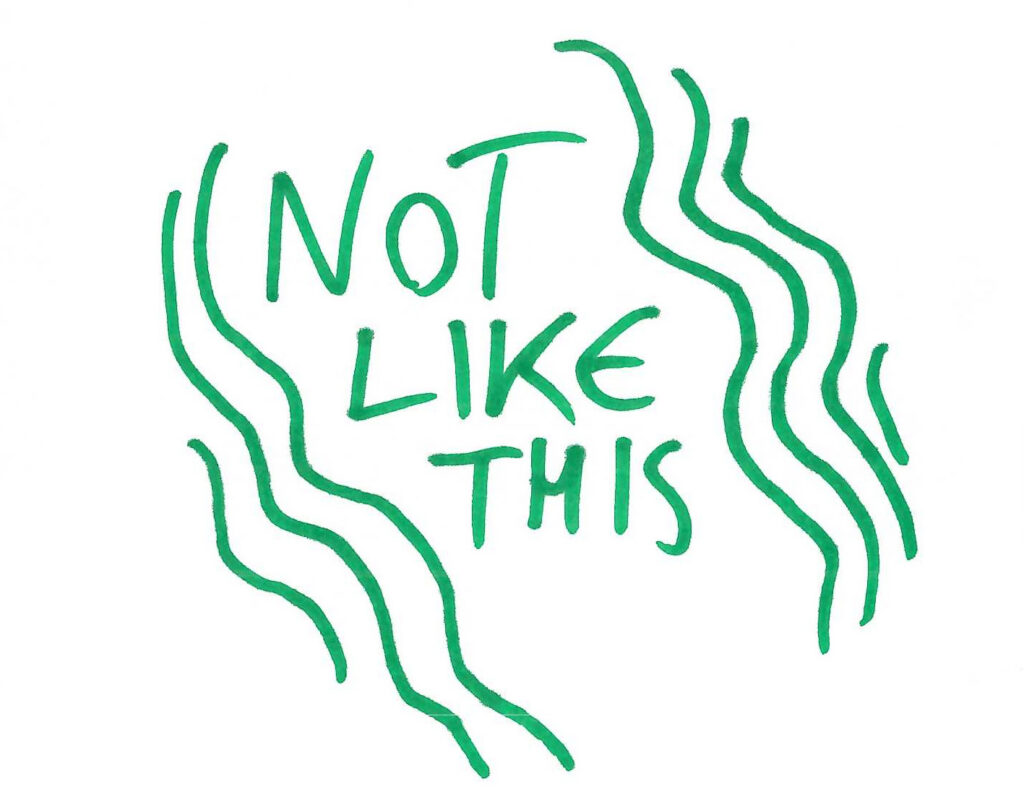
“Not this” (or “not like this”) is also a typical limited no. You can follow up later, after you thought about it for a bit, and are ready to try it out with specific adjustments, e.g. lube or a blindfold.
“Not in front of other people” or “not here” might also be a limitation that makes sense for you, or might make things easier. This is not only a question when kissing someone; for example a performance that involves going naked into ice cold water to feel how you are a part of nature might be much easier if no one is watching. After all, surpassing your own boundaries can make you another person; that is already intense enough on its own, and an audience can reinforce this in overwhelming ways.
“Not again” is also a valid boundary (of course). Maybe you wanted to try out something, to be able to say whether you like it or not. Communicating this soon after the experience may be good so the other person doesn’t expect it to happen more often, and be a good beginning for a conversation what you learned about yourself while trying it out. A good partner will be interested in your reasons.
Of course there is also the final form of the no, the “not with you”. That you don’t trust someone enough with something can be a painful realization. Hearing that you do trust others with it (or seeing later for themselves) can be very painful for the other person as well. Thousands of stories and songs about jealousy that are founded on this feeling, it brings out the worst in us.
“Not with you, as long as” or “not with you, because” can help specifying this in a way the other person can learn from. They might be able to regain your trust, decide that it isn’t worth the trouble, or do things better with the next person. It can be annoying if they want to prove to you that they have changed; especially if they mistook a “no, because” for a “no, as long as”. In such a situation going back to the simple and repeated “no” might be necessary.
picking the other up after the drop: disarming the no
To people with rejection sensitivity, a rejection can feel like a personal attack. It can cause emotional distress, insecurity, and a dopamine drop that can ruin their day.
Be careful: some people might raise this as an excuse for their behavior, or might try to manipulate you with this, implying that you hurt them. I can only repeat: no. they hurt you, or you would not have had to draw the boundary. They have no claim to you. They should learn how to deal with Rejection Sensitivity if they struggle with it, and it is not your responsibility to fix this.
But if you love them, you might want to fix it, and help other people through the drop. This is what worked for me:
- First I draw the boundary and get out of the situation. You can’t help the other person with anything before you feel comfortable again. All the tips from above apply.
- This can also mean to regulate yourself briefly. Drawing a boundary is usually intense and unsettling. Do something nice for yourself, like a piece of chocolate, masturbating, or calling a friend.
- Then you can move on to understanding why you just needed that. What was uncomfortable to you? Do you need a “no”, a “not now”, a “not like this”? What did you want the other person to do differently, what did you want to do differently? Be honest to yourself (this is why you should do this in a quiet moment, when you’re alone).
- Only then should you come out and ensure the other person that everything is fine between you two. You can explain your boundary if you didn’t already, or limit it to certain conditions. You can tell the other person that you still love them (if you do) and that they did nothing wrong (if they did not).
- After that, it can make sense to write it down, especially if such situations happen more often. Writing down your experience can help detecting toxic patterns in your relationship, so you can talk about it. If the other person denies your perspective, reading your written account can be sobering for them.
This is what I try to do in such situations – depending on how painful your past experiences were, it can be easier, or more difficult. For me it helps with healing from past trauma; helping the other person with not repeating bad behavior is stopping it for others, as well. (For the difference between Punishment, Justice, and Healing, I can recommend this great article about the white supremacy culture.)
In the long run, unmet needs can lead to resentment in any relationship. This is why understanding your needs and boundaries, and voicing them, is so important for healthy long-term commitment. It can also help with gaining confidence in all kinds of interactions. And with dismantling patriarchy, of course.